Why Equipment Hire Businesses Should Collect Customer Card-on-File Details
Stop chasing refuelling and cleaning fees. Save your customer's card when they sign, then charge fuel, cleaning or damage in one tap with Signd Pro.
Tom - Founder of Signd
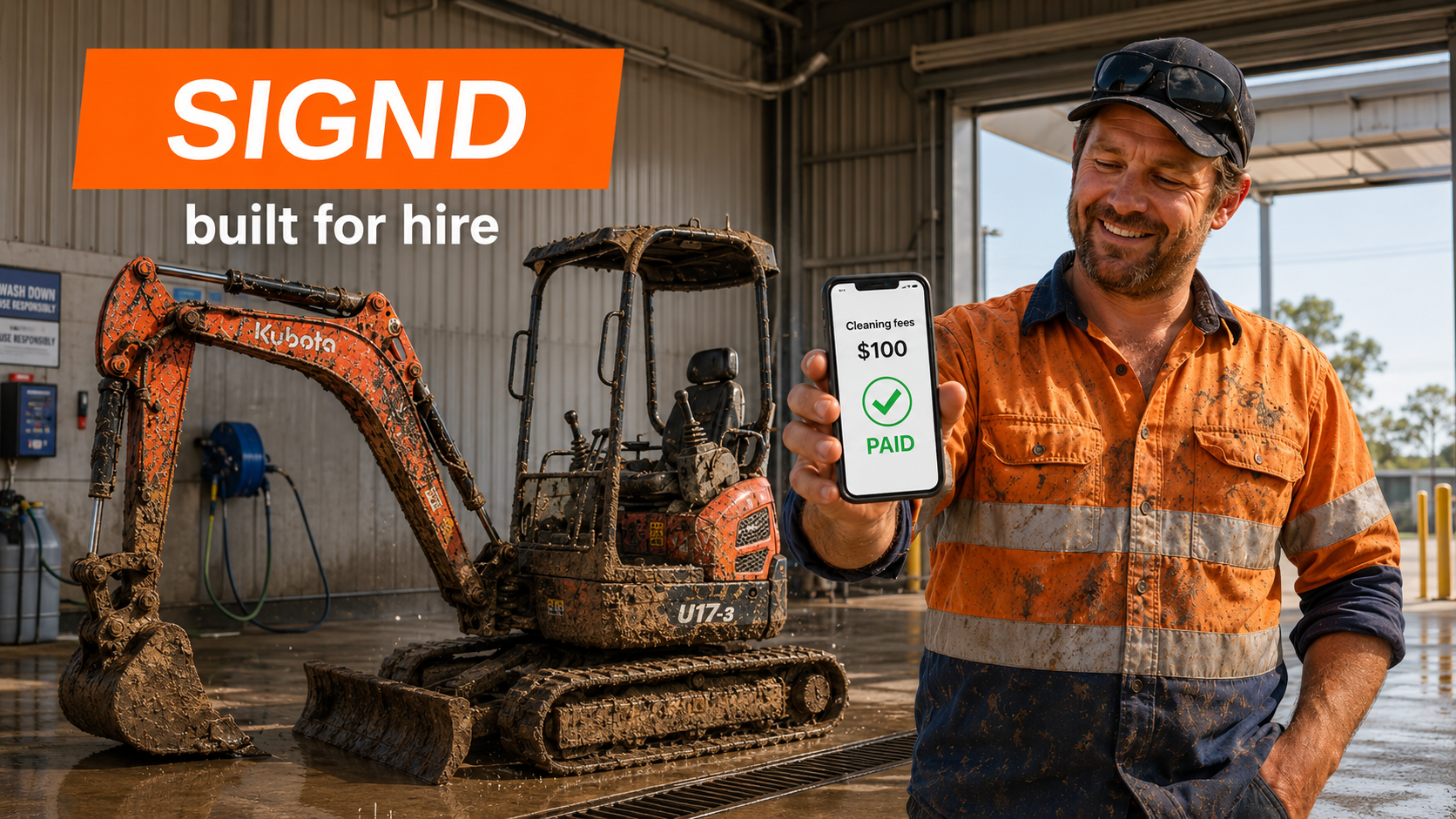
Running an equipment hire business is a capital-intensive game. You invest significant capital in a fleet of excavators, trailers, scaffolding, or specialised tools. Profitability depends entirely on asset availability and minimising the "invisible costs" that occur between hires.
One of the most persistent drains on profit isn't the machine itself. It is the time and money lost on the "extras." This includes half-empty fuel tanks, mud-caked bobcats, missing bucket pins, or machines returned hours late.
Individually, a $50 refuelling charge or a $120 cleaning fee might seem small. Multiply those by 20 hires a week, and you are looking at thousands of dollars in lost revenue every month. Many operators write these costs off because they don't have the time to chase a customer for a small payment after the main invoice is settled.
This is where the "Card-on-File" model changes the game. By securely collecting and verifying payment details at the point of signing the hire agreement, you move from chasing money to managing your business.
What is a Card-on-File and How Does It Work?
A card-on-file (CoF) allows a customer’s credit or debit card details to be captured and stored securely in a digital vault. They can then be charged for future transactions related to their agreement.
It is the same model used by hotels for incidentals or car rental companies. You provide your card up front, and if you bring the car back empty, they charge the card automatically.
With Signd Pro and Stripe connected, you can ask for a card on any agreement. Your customer saves it before signing, and saving it doesn't charge it. These details are vaulted by Stripe, one of the world’s most secure payment processors.
Why Chasing Invoices Kills Profit Margins
For many hire yards, the return of a machine triggers a manual, frustrating admin cycle.
- The yard hand notes the machine needs $80 worth of diesel.
- The office manager creates a manual invoice for $80.
- The invoice is emailed to the customer and often ignored.
- Two weeks later, the office manager calls the customer to follow up.
- The office manager spends 15 minutes debating the charge or deletes the invoice to avoid the hassle.
This process is a hidden killer. If your staff spends three hours a week chasing $50 fuel charges, the wages spent often exceed the value of the fuel. When you have a card on file, that $80 charge is processed instantly. There is no invoice to chase and no awkward conversation.
Recovering Legitimate Additional Costs
A verified card on file allows you to recover costs that are rightfully yours under the terms of your agreement:
- Refuelling Charges: If a machine leaves full and comes back at 75%, that's your money in their tank.
- Cleaning Fees: If a machine requires a two-hour pressure wash before the next hire, you should be compensated for that labour.
- Damage Charges: Minor damage like cracked lights or broken mirrors is common. A card-on-file helps make sure you aren't paying for customer mistakes out of your own pocket.
- Late Return Fees: Charging a late fee protects your schedule and asset turnover.
- Missing Equipment: Auger pins, safety chains, and manuals are expensive to replace. Customers are more careful when they know their card is linked to the hire.
Real-Time Verification
Manual card collection carries risk. Hand-written numbers are prone to error, and customers may provide expired or "dummy" cards.
Signd uses Stripe to power card-on-file features. When a customer enters their details during signing, the card is verified in real-time. That cuts the risk of discovering a fake card days later, although a saved card can still be declined or disputed.
Security and Compliance
Handling credit card data is a massive liability. Writing card numbers on paper agreements or storing them in spreadsheets likely breaches PCI compliance standards. If that data is leaked, your business faces significant fines.
By using Signd’s Stripe-powered integration, you never touch the card data. The information goes directly to encrypted servers. You only see the last four digits and the card type. This gives you the power to charge the card without the burden of securing sensitive data.
Workflow Comparison: Traditional vs. Signd
The Traditional Way:
- Customer signs a paper form.
- Machine returns dirty; you call the customer.
- Customer argues; you send an invoice.
- 30 days pass and the invoice remains unpaid.
- You write off the $150 loss.
- Total time spent: 45 minutes. Revenue recovered: $0.
The Signd Way:
- Customer signs digital agreement and provides card-on-file.
- Machine returns dirty.
- You record the mess in a post-hire inspection, then open Card, tap Charge card on file and enter the amount and reason.
- Your customer gets a receipt.
- Total time spent: 2 minutes. Revenue recovered: $150.
Protecting Your Cash Flow
Cash flow is the lifeblood of any rental business. When money is tied up in unbilled damages or pending fuel invoices, your ability to maintain your fleet is squeezed.
A card on file means you can charge agreed fees as soon as the gear is back, instead of waiting on an invoice. That helps protect your profit margins.
Protect your profits and eliminate hours of admin. Card on file is part of Signd Pro. Try it free for 7 days. See Save a card and charge it later.